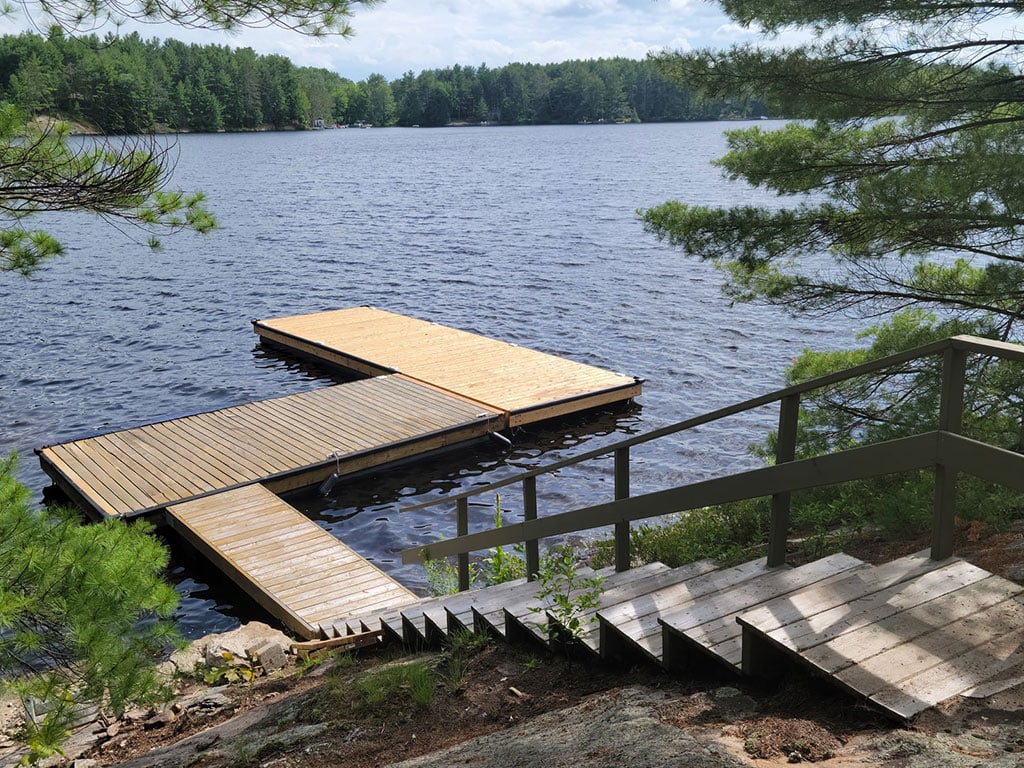
Floating vs Permanent Docks in Ontario
Floating and permanent docks both work — but only in the right conditions.
There’s No “Best” Dock — Only the Right Fit
Dock systems are often presented as simple choices. In reality, what works well on one lake or shoreline may perform poorly just a short distance away.
Floating and permanent docks are built for different conditions. Knowing how each behaves helps you avoid unnecessary maintenance, instability, or costly changes later.
Floating docks sit on the water and rise and fall with changing water levels. They’re supported by flotation systems rather than fixed posts driven into the lakebed.
When properly designed, floating docks offer flexibility across a wide range of Ontario shoreline conditions.
Floating docks are often well suited for:
- Areas with fluctuating water levels
- Soft, rocky, or uneven lake bottoms
- Shorelines affected by ice movement
- Deeper water near shore
- Locations where seasonal adjustment matters
Permanent docks are fixed in place using posts, piles, or cribs anchored to the lakebed. Their height and position remain constant relative to the shoreline.
When conditions are right, permanent docks can feel very solid and require minimal seasonal adjustment.
Permanent docks are often best suited for:
- Shallow, consistent water depths
- Firm, stable lake bottoms
- Protected shorelines with limited wave action
- Areas with minimal water level fluctuation
Floating Docks
- Adjust automatically to water level changes
- Adapt well to varied bottom conditions
- Often easier to modify or expand
- Can be adjusted for seasonal conditions
Permanent Docks
- Fixed height and position
- Rely heavily on lakebed conditions
- Limited flexibility once installed
- Can require more planning and permits
Ontario’s climate plays a major role in long-term dock performance.
Floating docks often handle ice movement and seasonal changes well — especially when designed with proper anchoring and layout. Permanent docks can also perform well but may be more vulnerable to ice pressure if conditions aren’t ideal.
Long-term performance depends less on dock type alone and more on how well the system matches the shoreline.
The best dock choice depends on a combination of factors, including:
- Water depth and bottom conditions
- Exposure to wind, waves, and boat traffic
- Seasonal water level changes
- Intended use and foot traffic
- Long-term maintenance expectations
That’s why dock selection should start with your shoreline — not a default dock style.
Not Sure Which Dock Type Makes Sense for You?
If you’re weighing floating versus permanent docks, we’d be happy to review your shoreline conditions and help you understand which option fits your waterfront best.
Get My EstimateNo obligation — we’ll review your details and be in touch within 1 business day.